|
|
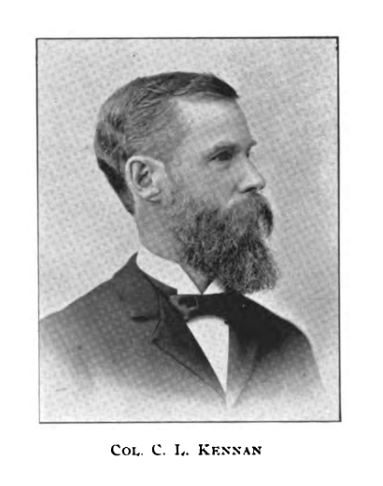
Col. C. L. Kennan
Cortland L. Kennan is the son of Jaras and Charlotte E. (Gardiner) Kennan, one of the pioneer families of Huron county, the father having took up his residence here in 1831. The son was born December 29, l847.
He was educated in the public schools of Norwalk, and at Adelbert
College, from which he graduated in 1876. He afterwards studied law,
and has been one of the prominent members of the Huron county bar.
Mr. Kennan has a decided love for military affairs. In 1877 he joined
Co. G., 16th Regt., O. N. G. He was promoted rapidly and became First
Lieutenant in 1882. In 1887 the company was transferred to the 5th
Regt., and in 1887 he became Lieutenant Colonel. He was elected as
Colonel in 1893. Col. Kennan, as a commanding officer, is regarded as
one of the best in the National Guard.
|
|
|
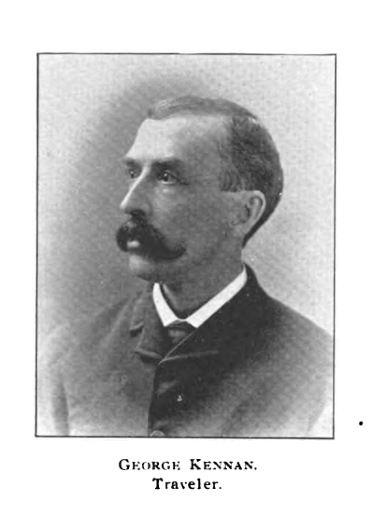
George Kennan
was born in Norwalk, Huron County, Ohio, February 16 1845. He was
educated in the public schools of his native town, and in 1862 attended
the Columbus Ohio, high school, while working at night as a telegraph operator.
In 1864, he was assistant chief operator in the telegraph
office in Cincinnati, and in December of the same year went to Kamchatka
by way of Nicaraugua, California, and the North Pacific. As leader
of one of the Russo-American telegraph company's exploring parties in northeastern
Siberia in 18655-6, and as a superintendent of construction for the middle
district of the Siberian division from 1866- 1868, he
explored and located a route for the Russo-American telegraph line,
between the Okhotsk sea and the Bering Strait, spending nearly three years
in constant travel in the interior of northeastern Siberia, and returning
to the United States on the abandonment of the enterprise in 1868.
In 1870 he went to Russia to explore the mountains of the eastern Caucasus,
proceeded down the Volga river to the Caspian sea, made extensive explorations
on horseback in Daghestan and Chechnia, crossing the great
range of the Caucasus three times in different places, and in 1871
returned to this country. In 1885-6 he made a journey of 15,000 miles
through northern Russia and Siberia for the purpose of investigating the
Russian exile system, visiting all the convict prisons and mines between
the Ural mountains and the head waters of the Amoor river and explored
the wildest part of the Russian Altai. Since his return from
Russia he has become very famous as a lecturer and writer on what he saw
upon his travels.
|